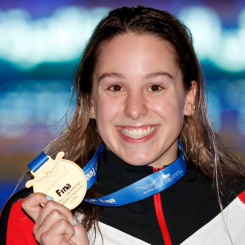
Tessa Cieplucha

Tessa Cieplucha
CAREER HIGHLIGHTS
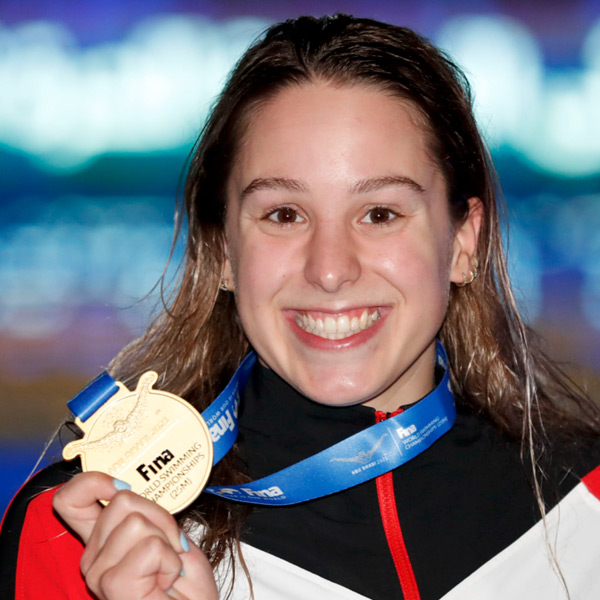
Olympian | World Champion | NCAA All-American
Hometown: Georgetown, Ontario
Team: University of Tennessee / Team Canada
Career Highlights
Olympic Games
- 2020 Olympian (Tokyo) – 400m Individual Medley
World Championships
- 2x World Champion
International Competition
- Pan American Games Champion
NCAA Division I Career (University of Tennessee)
- 8x NCAA All-American
- 2x SEC Champion
Tessa Cieplucha is a testament to the power of patience and perseverance. A standout competitor for the University of Tennessee under coaches Matt Kredich, Rich Murphy, and Sean Baker, Tessa developed into one of the world’s premier IM swimmers.
Her journey took her from Georgetown, Ontario, to the pinnacle of the sport, representing Team Canada at the Tokyo Olympics. Tessa is known for her mental fortitude and her ability to execute under pressure. As a clinician, she draws deeply from her personal experiences to help the next generation of swimmers understand that success is a process, not an overnight event.
FROM THE CLINICIAN
The Late Bloomer: I always grew up being the underdog. I wasn’t the standout, flashy winner in my age group, and I didn’t make my first Senior National Team until I was 20 years old. But I always had big goals. The longer I swam and the harder I worked, the more I began to pass the athletes who used to beat me.
I love sharing this with young swimmers because many of them feel discouraged in middle school if they aren’t winning everything. I am living proof that if you stay true to your goals, you can bloom later in your career. Most of my success came after college, and I want kids to know that their current struggles are just part of the journey.
A Ten-Year Plan: My passion comes from remembering when I was 12 years old. That was the year I made the goal of becoming an Olympian. I wrote my goals on my mirror so I could see them every single day. It wasn’t immediate—it took 10 years of dedication—but I achieved that dream. I break down my swims into training goals, not just racing goals. I used to look at the splits I wanted to hit in a race and figure out exactly how to hit those paces in practice.
Mastering the Mental Game:Swimming has taught me how to stay grounded when things get chaotic. A perfect example was at the World Championships. During the warm-up for the final session of the 400 IM, the pool was so busy I couldn’t even swim a 25 without stopping. It was stressful, but I reverted to my mental training. I refused to let it disrupt my preparation or get in my head. That night, I became a World Champion.
Whether it was navigating the crowded warm-up pool or dealing with the uncertainty of the COVID-delayed Olympic Trials, I learned that if you want something bad enough, you can make it happen. I teach swimmers that there is no such thing as a “bad” swim—everything is a learning opportunity.